
Giving USA 2026 is here!
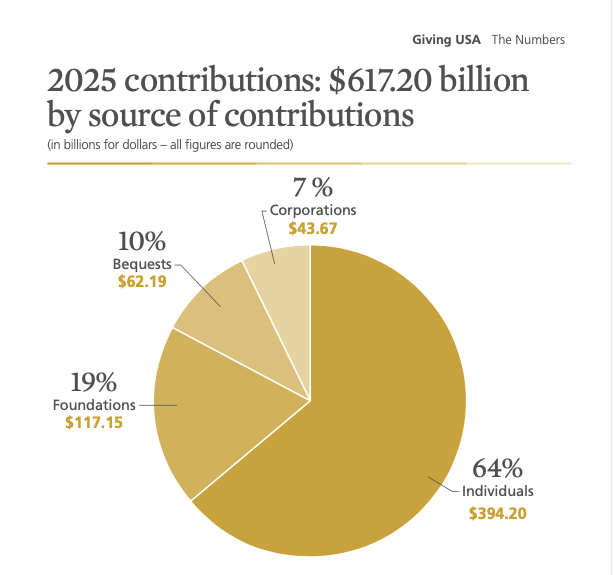
In 2025, total giving across the United States reached $617.2 billion, a 5.7% increase from 2024. That’s good news, showing that people and institutions continue to invest in nonprofits and their missions. Many nonprofits depend on that generosity.
As a former chair of The Giving Institute, the membership arm of the Giving USA Foundation, which funds and publishes the annual report, I look forward to release day.
Many across the nonprofit and philanthropic sectors will take time to unpack what the data mean. The focus, as always, will largely be on individual giving (the largest single segment at 64%) and Foundations (19%). Are fewer donors giving more? Yes. Are mega-gifts skewing the total? Also, yes. Are all nonprofits seeing the same amount of lift at a time when funding cuts abound? No.
What About Corporate Giving?
Corporate giving often gets the least amount of focus, perhaps because it comes in at a mere 7% of the total pie. But that 7% is important – as is every gift. Plus, as Jon Bergdoll, Interim Director of Data and Research Partnerships at the IU Lilly Family School of Philanthropy noted on a release-day webinar hosted by Johnson Grossnickle and Associates (a Giving Institute member firm), “corporate giving grew the most among the sources in the past five years.” Bottom line – we need all giving, in all forms.
When trying to dissect corporate giving, which is already difficult because of the varying sizes of business across the country, there’s a lot of focus on in-kind contributions (think tech and pharma, software, and medications), donations to which companies can assign monetary value.
Other Ways to Give
But there’s another valuable form of in-kind contributions companies make to nonprofits that’s missing from this annual analysis. Skills-based volunteerism: the value of corporate employees investing their time and talent (during work hours, I might add) to help nonprofits thrive. Companies and nonprofits alike should invest in this powerful act of giving. It benefits everyone.
In addition to building nonprofit capacity in a truly meaningful way (no, not all volunteerism does this), skills-based volunteerism deepens employees’ connections to community. Data from SAP’s Social Sabbatical, their flagship skills-based volunteering program, tells us, 93% of those who participated in their program reported an “increased interest in searching for ways to engage in their communities.” That means more Agents of Good out in the community, investing their own dollars, which, yes, will show up in individual giving (but, again, we need it all).
There’s a saying in fundraising that “volunteers make the best donors.” In addition to making a huge impact on their own, the gifts of time and expertise show a deep level of commitment to a cause, a commitment nonprofits can and should cultivate.
If you’re at a company, looking for a way to engage your people in impact work, know this. Skills-based volunteerism helps build employee wellness, engagement and skills. It also helps you elevate your brand while investing in the community. If you’re at a nonprofit, seeking skill sets you might not have on your own team or some pro bono help for a key project, consider skills-based volunteerism as a powerful strategy.
It’s a powerful way to give.